Showing posts with label ALES 204. Show all posts

Friday, 13 April 2012

Setting the Sun on ALES204

So much has changed since that first ALES 204 class, when we had to talk with the strangers beside us and silently thinking; "this sounds pretty silly...". Today, there are a few less strangers in the class and I'm thinking that I was silly for judging the class without knowing anything about it.

First of all, I thought Twitter was just Facebook statuses like "At the park with my dog", "Eating the most delicious ice cream!", etc. and I did not feel like having that added into my internet time. But as ALES 204 taught me that there is a lot more to it, there are many businesses and professionals with Twitter accounts and their tweets are actually worth reading. They contain news or interesting information. Twitter is a good way to make connections within your respective career field, something that I am currently building on. I am presently following Pioneer Hi-Bred, AFAC, CFA, AB Pulse Growers and Alberta Beef. They are all agricultural organizations and two of them I had applied to for a summer job. Jami also discusses her similar adjustment to Twitter in her blog and how she warmed up to it and started creating connections to other people in her field. Another thing that I found valuable was the lectures on professionalism. I found this very relevant and useful because I was applying for summer jobs and wanted my resumes and email to make me sound a step above the other applicants. The tips shown on what to include in a CV and/or resume was great, because it showed me changes that I should make to mine to make me sound better and make the flow of the document smoother.

Thirdly, there were the lectures and labs on presentations. These were slightly helpful because they pointed out a couple neat tips on being a better public speaker and making presentations more interesting. I have had plenty of experience with public speaking with 4-H, and feel that I am an alright public speaker, but even with this background, MC had plenty to teach me with her lecture. In her PowerPoint, she debunks myths about public speaking and how to improve the effectiveness of a speech. MC also did a lecture on PowerPoint presentations, demonstrating how the use of colors and the background can be distracting or hard to read, thus disengaging the audience. This was a great tip! When you are young, you like using bright colors and interesting backgrounds, but these things are actually very distracting and draw the audiences attention away from what the presenter is really speaking about.

Finally, is this blog. It was a different, intimidating experience to write your thoughts and opinions on a blog where you know that ANYONE can read it. But as I wrote a couple posts and read other classmates blogs, I gained confidence and grew more comfortable writing my thoughts about the topics. This experience has made me want to create my own blog for our family farm or maybe even a website (need to learn how first). This way we could communicate with our consumers more effectively and also could keep them updated on what is happening on our farm. Spring Creek Ranch has created a website, available here, to conduct business, share information (like recipes) and keep consumers informed as to whats new. Our farm would not need something so developed at the present because we are not as large as Spring Creek, but we would exploit its uses similarly.

Throughout the winter semester I have also commented on fellow students blogs. I usually chose ones that I could relate to or taught me something interesting. My comments are on Evelyn, Brittany, Julie, Kandice and Cassandra's blogs.


Figure 1: Sunset Photo courtesy of Jessica Carlyon (2012)


Good bye ALES 204...


Friday, 23 March 2012

Editing Wikipedia Stubs - Canadienne Cattle

These past couple weeks in my ALES class we have been exploring the world of copyright, referencing and the reliabilty of resources. To provide a hands-on experience, we were required to edit a Wikipedia stub; an article with little or limited information. I chose to edit the one on Canadienne cattle, because there was very little written on it and I'm a cattle girl, so I enjoy learning more about breeds, especially the only one developed in Canada! You can click here to see the article and learn more about Canada's dairy breed. My classmate, Rosie, also edited a WIkipedia article on a cattle breed. In her blog she discusses the difficulty of finding reliable sources on Gelbvieh cattle and her journey of learning how to edit a Wikipedia article. Both breeds have interesting stories with their history and their existence in Canada. Canadienne cattle were first brought over in the 1600's when the French were colonizing modern-day Quebec. They developed into a hardy breed to survive the harsh Canadian environment and to produce milk efficiently. Today they are an endangered breed that breed associations are actively working at increasing their popularity and population.
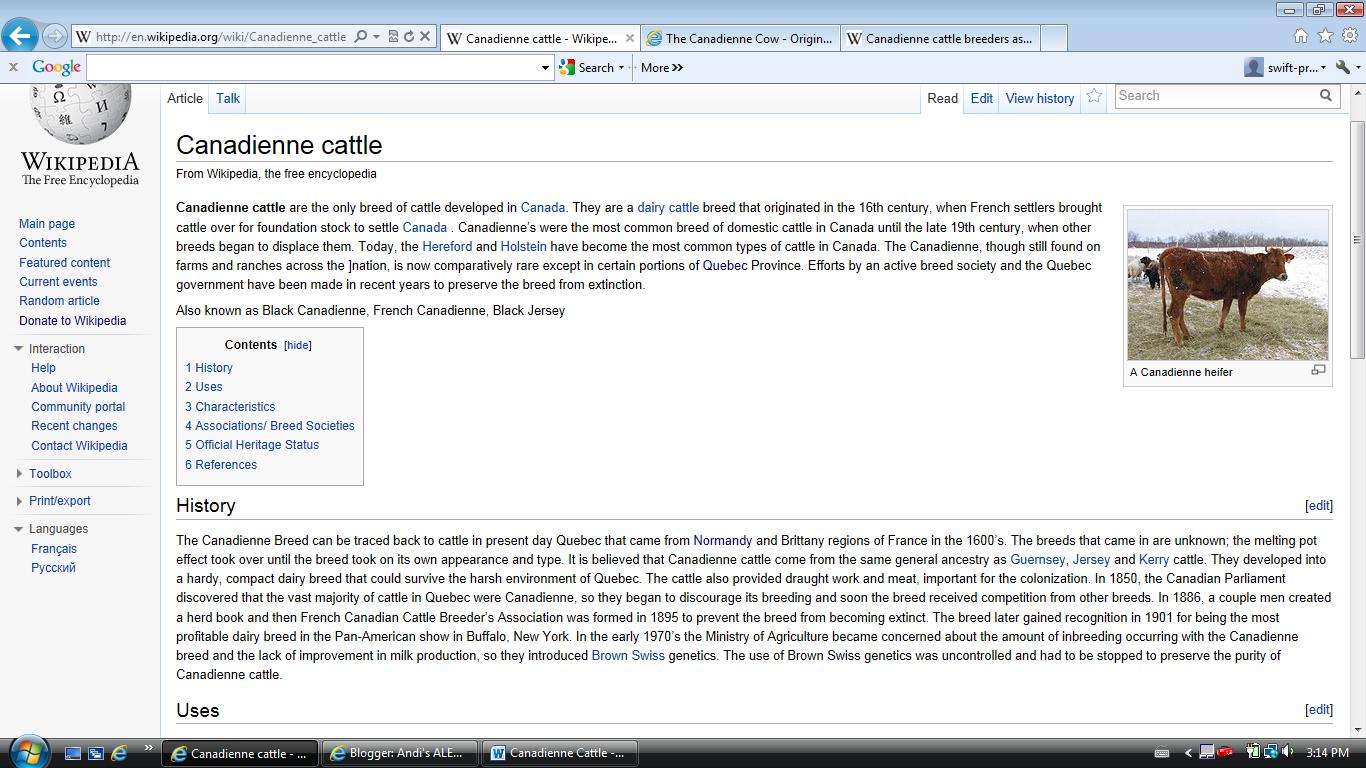
Original Canadienne cattle stub
(Andria Carlyon, <http://en.wikipedia.org/wiki/Canadienne_cattle>
retrieved March 22 2012)
This picture is of the original article, and as you can see there is only a short paragraph about the breed and two references. It does have a good picture of a Canadienne heifer that gives the viewer a good representation of the breed's appearance.


New, updated Canadienne cattle stub
(Andria Carlyon, <http://en.wikipedia.org/wiki/Canadienne_cattle>
retrieved March 23 2012)

For my article, I added more headings to sort the information and provided some more references to give the information more reliability, one was a peer-reviewed article about the genetic differences between Canadienne cattle and other dairy breeds. If someone reading my article was not very knowledgeable about Canadienne cattle, it would quite easy to have errors go unnoticed and used by readers. I could have changed the dates about when the breed got heritage status, or stated that they did not exist on any ranches outside of Quebec and because the errors would have been minimal, they could be looked over. This could happen with any other articles and stubs on Wikipedia, either intentionally or not.
Therefore, I do not think that Wikipedia should ever be used as a resource when writing papers or articles. It can be used to gain a quick, basic understanding of the subject, but the information should not be used in the writing. The same information should be found on from other sources that are reputable if the Wikipedia article had the correct, error-free material.


Monday, 16 January 2012

My Debut to Blogging

     Hello, my name is Andi and I am currently in my second year of my program at the University of Alberta. I am taking Bachelor of Agriculture, majoring in Animal Science. I transferred here this year to further my education in the agricultural field and am so far really enjoying my classes. They are helping me discover what parts of the agricultural field I like more and may be interested in pursuing further as a possible career. I do know that I love working with animals and will probably be working with cattle and horses in my future; hopefully ones that I own myself.

     I love the aerial photos of farmland (like this one) or looking out of the airplane window at all the square fields and the yards with the trees and buildings. It shows me a different, broader persepective of how much land Canadians farm and grow crops on.
     I have found that social media has been slowly invading my life from all areas. School has been using it more and more to appeal to students growing interest in the internet and all of the things it offers. This increases students participation because they are already online and it is only a click away to check out something for school. Some teachers have difficulty using Youtube clips because they are blocked by the school. In this article about using Youtube safely at school, the authors discuss a website called VuSafe that allows teachers to access and use Youtube videos without the inappropriate material popping up.
     Twitter is being used by companies, weather and news networks and interest groups to keep their followers updated on new and important changes. I was not very fond of the idea of twitter initially because I thought it was too similar to the statuses on Facebook but now that I was required to join for ALES204, my dislike has decreased. It is a very simple way to communicate with people and organizations that you do not have a strong affliation with, but are interested in. Twitter will be a method for me to find out about new discoveries in the agricultural field, but I have yet to search for someone or some group to follow that will allow me to do this.
     I have had Facebook for a while and I usually use it for finding out what friends are up to, chatting with long-distance friends or just 'creep' to find out the latest gossip that Facebook can tell me about my friends. A fellow blogger, Danielle Becker discusses on her blog how important Facebook, Skype and email were to her to communicate with her friends and family when she moved to Wales. Because of Facebook's extreme popularity, many companies and organizations have created Facebook pages to advertise and inform people about themselves. It is an easy, inexpensive way to appeal to a large population. The agricultural sector is also taking advantage of this to increase young people's awareness of the career and other future opportunities available.

     I am looking forward to learning more about social media and how I can utilize it for school, research and other places in my future.